Last updated: May 2026
I am not sure how most people choose to have their damaged photographs restored, but I imagine it is much like choosing a mechanic to repair your car. You search for some online reviews, look at prices, call around and talk to a live operator until you find someone who seems knowledgeable and professional. And then, you trust your instincts and choose who will repair your car. This is a reasonable approach, but it leaves many questions unanswered.
So when a restoration goes wrong (looks poor, looks good but somehow feels 'off'), the item gets brought to us for a second opinion. Most importantly, the window of opportunity to fix whatever mistakes were made goes down significantly because the first artist made a number of irreversible decisions about the way the image looks. Decisions about grandpa's jawline. Decisions about how to smooth out noise (or other artifacts) from a 60 year old Kodachrome print. Decisions about whether or not to fix minor tear damage or pulled staples, versus just hiding the problems with a painted-over branch of a tree.
So when you think about it, you're trying to evaluate a craft that you probably don't practice yourself, and you're handing over something that genuinely cannot be replaced. That means the real work starts before you ever send the photo out. It starts with the questions you ask.
So let's get into it.
Protecting Your Original Photo
What Happens to My Original?
We can't stress this one enough, yet surprisingly, it gets barely mentioned.
Professional restoration preserves the authentic character of your original photograph while carefully repairing damage.
When we have an original print, we often send that to the service for scanning, but we also want to know what happens to the picture from the moment it goes in the mail until it comes back to us. How quickly will it be scanned upon arrival? Will it be stored in a climate controlled archive or tucked away in a cardboard box in a back room? And when can we expect to receive the scanned picture back in our hands?
Our customers have told us some horrible stories about experiences with other scanning services - photos left sitting around for weeks, hidden charges for return shipping, poor quality scans. Our customers expect better, and we deliver on that promise. Every photo is handled with care, scanned professionally and promptly, and returned to you when promised.
Forever Studios tracks every item of physical matter, from incoming packages to outgoing ones, all the way through. If you ask a restoration service what they do with your physical photos, and they can't give you a specific, detailed description of exactly what that is, then you've probably learned something important about their service from that failure.
Founder Zachary J. Goldberg: "People send us photos of their grandmother's wedding, their father in uniform, their family's only picture from a country they left decades ago. If we haven't built a process that can tell you exactly where that photo is at every step along the way, then we haven't built a process worth trusting."
Can I See the Scan Before You Start Working?
You'd be surprised how many people skip this entirely. They send the photo off and just assume the rest is handled. But the scan is where the whole process starts, and if it's not done well, you're already working from a compromised source before any restoration even begins.
High-resolution scanning captures every detail of your original before any restoration work begins.
To me, "done well" means that you're reproducing the full dynamic range of the original print , all of the deep blacks of the shadows and the bright whites of the highlights. The grain of the paper is also something that is difficult to reproduce and is an element of an vintage photo that many people feel is part of the photo's character and should not be treated as simple noise to remove.
You've asked two questions. First, what resolution do they scan at and two, can you view the raw file before they begin to tinker with the image. I'll answer your first question first. 600 DPI is the minimum acceptable level of resolution for true archival purposes. Forever Studios won't offer a lower resolution service. Most companies that spend time to professionally scan and restore images won't offer a lower resolution service either. Services that offer 300 DPI images are peddling web thumbnails at best, not image restoration for display.
We can tell a lot about a service by scanning a single film from the client. Then, years later, you see the restored product and can tell even more about the service through the problems inherent in the input. Dust, uneven lighting, color distortion from a subpar flatbed, and these problems are always going to be there.
Want to know what real photo scanning entails? Check out our photo scanning service page to find out!
Who Does the Work and How
Almost nobody asks this, and it might be the most important question on this entire list.
Scanning resolution matters , higher DPI preserves more detail for the restoration process.
Some companies specialize in photo restoration and have full-time employees that specialize in the art. Their employees can spend all day long restoring photos for a living, and have perfected the technique after years of practice and can produce some truly amazing results. Other companies, however, farm out their restoration work to freelance "restoration artists" who are working on a piece by piece basis, and in some cases offshore, in countries where very low wages are paid to individuals who can do multiple restorations at one time in order to keep costs down. It would be unfair to generalize that either method is inferior to the other, however, it is up to you to decide which level of quality you are seeking and find out what kind of work a particular company does before you place your order.
When it comes to photo restoration, there is a big difference between good and great. Most of that difference is not based on the artist's ability to use Photoshop well, although that is important too. There is a huge component of judgement involved in knowing when to stop, when to call something restored and when to keep tweaking it until it looks too good to be real. This kind of judgment does not come from online tutorials or YouTube videos. It comes from years of practice and developing a workflow to help you not repeat your mistakes.
So ask about work experience, location and years of experience. If the contractor can't give you solid, thoughtful answers to these simple questions it is a huge red flag.
What's Your Approach When Part of the Image Is Missing?
This one, in our experience, is where you really find out who you're dealing with. We've seen it come up dozens of times with clients, and the answer (or lack of one) tells you more about a service than anything on their website ever could.
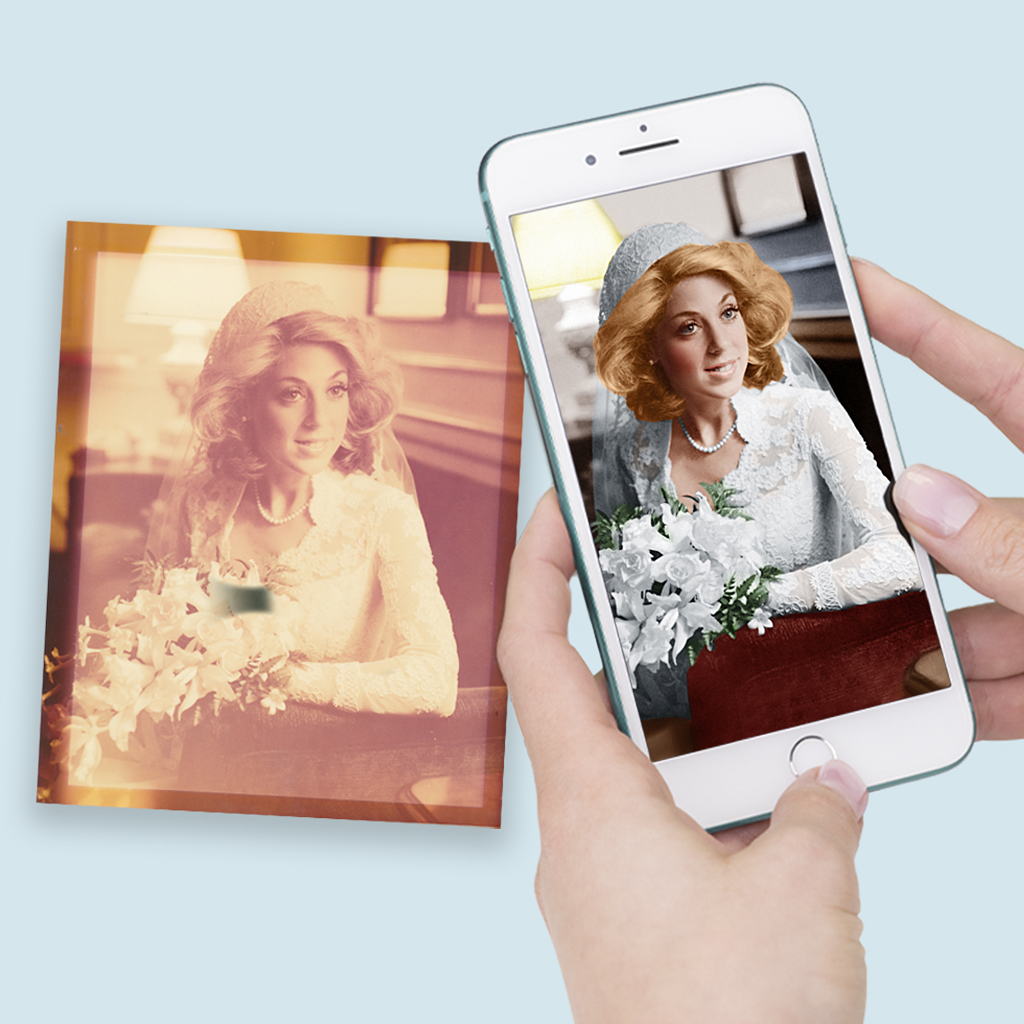
Reconstructing missing sections requires careful judgment about what originally existed in the photograph.
Other damage comes in the form of more drastic transformations: a half-shredded face, an image mostly dissolved in water, chunks of mold eating through the emulsion all the way to the paper backing. In these cases, the original information is unrecoverable. The question then becomes: what does the artist do with that blank space?
Am I taking a responsible approach to this or am I being irresponsible? The first step to this is to ask the family for reference photos of the same person. Study the facial structure and how light hits the face, and try your best to reconstruct what that would look like realistically. A realistic portrait restoration is one that looks responsible and believable for the actual subject, not just something that looks good at first glance. Irresponsible would be guessing certain things about the subject or even letting AI hallucinate entirely new facial features and have the family be none the wiser until they find another photo of the subject and something just doesn't look right.
Marketing Director Greg Evangelista: "Oh absolutely. The danger isn't that you're going to do a bad job restoration and it's going to look bad. The danger is that you're going to do a bad job restoration and it's going to look good. And then it's going to take the place of that person's image in the family's memory, and they'll never even think to question it."
I pay attention to how services explain how they handle missing information. Do they outline the specific decisions made, and give a clear sense of what they can and cannot fill in when data is absent? If not, it suggests that not enough thought has gone into the hardest part of the work.
Lead Restoration Artist Olivia: "When I'm working on a face that's half gone, I don't just start painting. I ask for every photo the family has of that person. I study the bone structure, the way the light falls on the other side of the face, and I build it back piece by piece. And if there's something I genuinely can't determine from the reference material, I tell the family that upfront. I'd rather deliver something honest than something that looks impressive but isn't really them."
Our before and after gallery contains actual examples of water, fire and storm damage restoration. Click on any of the images to view a closer look at how we can restore what you need.
The Details That Matter
What File Formats Will I Receive?
This sounds very technical, but it is extremely important.
For our clients who are not quite photo professionals, JPEG files are the images that you send to your grandmother or post on facebook, while TIFF files are the ones you keep on hard drive for safe keeping. Unlike JPEGs which actively compress your files, eliminating data to make a smaller file size, TIFFs capture and save your image 100% fully saturated with all the color information and resolution that your camera is capable of. Without compression, you have no fear of losing quality, and this becomes especially important in the future when you decide you want to blow up that one perfect shot from 5 years ago into a 24×36 canvas for your living room wall.
We deliver both TIFF and JPEG formats to our clients at Forever Studios. "Why TIFFs?" You may ask. Well, there are many reasons JPEGs are not the preferred format for image restoration. It's not that every lab that offers photo restoration services are hiding something, but having the original TIFF file opens up many more options for future restoration than a JPEG does. And let's face it, most of our clients are looking at these photos for the lifetime of their children, so future restoration options are usually a top priority.
Don't forget to ask about the DPI of the final output (300 DPI minimum for proper print quality, 600 DPI or higher recommended for optimal archival work) and the color space used (sRGB for output to screens and web and Adobe RGB for professional print output). Also, be sure to ask if you will receive the original, untouched scan as a separate file. This will allow you to have the photo re-restored with updated technology in the future.
How Many Rounds of Revisions Are Included?
A company's revision policy is far more revealing about the company than their marketing material.
Ideally you'd like to see 2-3 rounds of revisions included in the initial price. Then you can see their work, comment on a few things that don't quite fit "the skin tone looks off" or "that background detail wasn't actually there" and they go ahead and fix it for you while they're working their magic on the harder stuff where the artist is actually building something from scratch that no one's ever seen fully restored.
Here, revisions are not included, or individual revisions are $25 each (fair enough for a volume operation: if you order a basic color correction of a faded, high contrast faded beach photo, have it shipped out quickly and efficiently, and be happy with it). But that's a volume operation. This is not. This is a labor of love to attempt to recreate the likeness of your father from a yellowed, water damaged print.
What's the Actual Turnaround Time, Not the Marketing Number?
Every restoration service has a quoted turnaround time, and in our experience, most of them are aspirational at best.
The challenge of restoring an image from a damaged photograph is often not apparent from the thumbnail. What appears to be light fading to white in the thumbnail may prove to be dangerous chemical degradation visible at 600%. Often it is not until our artist opens the file at full resolution that the true extent of the damage becomes apparent. Such is the nature of restoration difficulty to predict before starting the job. Projects quoted at three days have turned into ten minute jobs and vice versa.
I pay less attention to the number they throw out for an estimate, and more attention to what actually happens if they end up being wrong. Do I get a phone call explaining what went wrong, and a revised revised estimate? Or does my inbox three weeks later contain a file with no explanation for the increase in time and cost that apparently occurred?
Be wary of anyone promising 24 to 48 hour turnaround on complex damage restorations. Seriously, reconstruction jobs take time. Even with the best software in the world, it takes time and good judgment to get it all right. Don't believe what they say. If they say they can fix your severe water damage in a night, then they aren't being honest about what they mean by "fixed".
Technology, Trust and Transparency
Do You Use AI, and If So, How?
This is a 2026 question that I've never really seen before, but it's becoming increasingly relevant.
AI tools and human expertise each have strengths , knowing when to use which makes the difference.
I wanted to mention how I use AI tools at Forever Studios to process images. I'm not ashamed to admit I rely on them (Topaz, etc) for tasks like upscaling, noise reduction and even color correction (many of the software packages have gotten REALLY good at the mechanical portion of those tasks). Where the software falls woefully short, is in making decisions about the image. It cannot look at a battered, torn and faded photograph of a man's father and decide what the man wants to see restored to clarity. That's up to us.
So what's the answer you're looking for? Yeah we use AI for the technical portions of the service but all creative decisions are made by a real human being. Because if you turned the service over to AI completely someone would probably notice that AI does some really weird things by default, like completely smooth out the texture of a human being's skin until they look like a video game mini character or things like that that actually happen right now.
And if a service tells you they don't use any AI at all? They're either behind the curve or they're not being straight with you, because every serious restoration operation in 2026 is using these tools in some capacity.
Lead Restoration Artist Olivia: "I use Topaz every single day , it's incredible for upscaling and cleaning up noise. But when it comes to rebuilding someone's face or deciding whether a shadow is damage or part of the original photo, that's where I take over. The software doesn't know the difference. I do, because I've been staring at these kinds of photos for years."
Our guide to restoration and retouching explains the technology and its limits in more detail.
What Happens If the Photo Can't Be Restored?
Not every photo can be saved, and any honest service will tell you that upfront.
Honesty comes in statements like: "We can recover about 80% of the detail. The lower left corner is going to be missing a portion of a frame, but we can restore the background of that area, we just won't be able to recover the missing hand of the lower left corner of that person."
You don't want to pay for restoration and end up with a poor job that conceals failures or even invents new details and tries to sneak them past you.
How do you act when you determine a photo is beyond full restoration? Do you charge for the assessment, and provide a digital scan of the undamaged original, at least? There is no shame in saying "we can't fully restore this one". There is a lot of shame in pretending to do something you are not going to do.
Can I See Examples of Work Similar to Mine?
Every restoration service has a before-and-after gallery on their website. Obviously. They picked their best work, and you'd do the same thing.
Even galleries that specialize in restoration can be a disappointing place to start. I recommend that you look for examples of work that directly relate to your specific problems. Instead of showing all of their restorations, look for examples of water damage restorations, examples of portrait restorations where half the face is missing, or examples of tintype restorations from the 1870s. Many galleries and restorers have not worked on any tintypes, and it is helpful to know this before they begin work on your photograph.
And here's the thing that people don't realize: different damage types require completely different skill sets. We've seen services that absolutely nail color correction on faded 1980s prints but completely fall apart when they have to reconstruct a torn section. And we've seen the opposite too , somebody great at structural repair who produces skin tones that look like they were run through a bad Instagram filter.
Take a look at real restoration examples that match your photo's condition. In our experience, that is the single best predictor of what you'll actually get back.
Pricing and Guarantees
What Does the Price Actually Include?
Restoration pricing is all over the map, and we mean that literally. We see quotes ranging from $15 to $300 for work that sounds roughly the same on paper, and the difference almost always comes down to scope.
Understanding what is included in restoration pricing helps you compare services accurately.
Services can be confusing when it comes to pricing, some offer a price per photo while others offer it per hour. Some services even include the cost of scanning your photos, color correction, repairs for damaged photos, and delivery of the finished product all into one price. However, other services are starting to leave some of these services unbundled, causing confusion over the total cost of restoration. So you think you're paying $45, and then scanning is extra, and high-res delivery is extra, and colorization is extra, and suddenly you're at $150 wondering what happened.
Get the basics straight before you commit to anything. Is scanning included or do you need to provide a digital file? Does the price cover all visible damage, or are certain repairs considered extras? Does the quoted price include revisions, or are those an additional charge? What format and resolution do you get back? Get those answers in writing. A service that can answer all of that clearly has a defined process. A service that responds with "it depends" to every question has not thought through their own workflow, and trust us, that lack of clarity will show up in the finished work.
The Forever Studios restoration guide breaks down what professional restoration typically includes and costs if you want a straightforward reference.
What Is Your Guarantee?
This is the question that separates companies who stand behind their work from companies who just want your money and move on.
A guarantee in photo restoration should mean something specific. Not vague language about "customer satisfaction" buried in the terms and conditions. You want to hear exactly what happens if you're not happy with the result. Do you get your money back? Do they redo the work? Is there a limit on how many times they'll revise it?
At Forever Studios, our guarantee is straightforward: we include free revisions until you're satisfied with the result. If we can't get it to where you want it, you get your money back. That's it. No fine print, no expiration date on the revision window, no "well technically the work was completed so we can't refund you." If you're not happy, we haven't done our job.
Founder Zachary J. Goldberg: "I started this company because I saw too many people get burned by services that took their money and delivered something they weren't proud of. Our guarantee exists because I believe if you can't stand behind the work, you shouldn't be doing the work. Every photo someone sends us is irreplaceable. The least we can do is make sure they're happy with what we send back."
You'd be surprised how many services either don't have a guarantee at all, or bury it in language so vague that it's essentially meaningless. Ask them directly: what happens if I'm not happy? If they hesitate or start talking about "policies" instead of giving you a clear answer, that tells you something.
The Question Behind All the Questions
So what's the real takeaway from all of these stories? That all of these questions boil down to the same thing: Does the service have a system backing it up.
Same photo sent to 5 different companies and repaired in vastly different ways. Sometimes the repair is excellent, and other times it goes wrong. This variability is due to differences in technology, training, decision-making, and restorative goals. And that's not random variation , it's the direct product of different equipment, different training, and different standards for what "done" means.
The photos people send us are not casual things. It's the last picture someone has of a parent. It's the only image from a country their family left behind decades ago. It's a shoebox that holds fifty years of someone's life in it. And that is what's actually at stake when you're making this decision.
So it deserves more than a quick Google search and a gut feeling. Ask the hard questions. The right company won't mind at all.
Frequently Asked Questions
How much does professional photo restoration typically cost?
We get asked about price ranges a lot. Minor restorations like simple fading and color correction tend to cost $25 to $50. Medium level restorations, like creases and small tears, cost $50 to $150. Heavy restorations, like missing sections or facial reconstruction, can cost anywhere from $150 to $300 or more. But seeing a price range on a website isn't that helpful, is it? Get a quote for your specific photo.
Is AI photo restoration as good as professional restoration?
For simple tasks, yes. AI is amazingly good at basic upscaling and noise reduction, to the point where we ourselves use the services offered by competitors for certain tasks every day. However, once you step into the harder stuff, it rapidly becomes apparent that AI has inherent limitations: for example, it is unable to realistically generate the missing eye of a close-up subject based on the clothing and appearances of family members, unable to tell genuine film grain from damage to the media, or realistically colorize a 1940s black and white photograph with historically accurate clothing colors without a human guiding it. For these and similar tasks, that ultimately require creative judgment, the best approach is to utilize AI as just one tool in the larger restoration workflow, managed by a trained and skilled restorer.
Should I mail my original photo or just scan it myself?
If you have a decent flatbed scanner (not a phone camera), scanning at 600 DPI or higher in TIFF format and sending the digital file is absolutely the safest route because your original never has to leave your hands. If you don't have scanning equipment, a good service will handle it for you, but make sure you understand exactly how they handle and return your originals. We offer photo scanning as part of our restoration service.
How long does photo restoration take?
Most basic restorations take around 5 to 10 business days to complete, while more difficult restorations can take up to 2-4 weeks. The software can process pictures in a matter of minutes, like Topaz, but some things like deciding where a jawline exists, getting the skin texture just right, and knowing when to stop refining require some thought and time. We would be immediately concerned if anyone could do a complex painting reconstruction overnight and promise it to be believable.
Can a badly restored photo be fixed by another service?
We get these cases all the time, where somebody had a photo "restored" elsewhere, wasn't happy with the result, and now they're bringing it to us. The honest answer is that it really depends on whether the original scan still exists. If we have the original scan, we can basically start fresh and the previous work is largely irrelevant. But if the only file available is the bad restoration itself, then we're working with damaged goods, because the previous artist's choices (smoothed textures, invented details, flattened tones) are all permanently baked into that file. We can still improve it, but we're starting from a worse place. This is exactly why we always tell people to keep the original untouched scan no matter what.
What's the difference between photo restoration and photo enhancement?
Restoration is about bringing a photo back to what it originally was , removing damage, correcting fading, fixing tears. Enhancement is about pushing it beyond what it was, like sharpening past the original clarity, colorizing a black and white image, or upscaling the resolution. Both are completely legitimate services, but they're very different scopes with very different price points. And the line between them has caused more billing disputes than practically anything else we've encountered in this industry. So just make sure you and the service are on the same page about which one you're actually paying for before any work begins.
How do I know if my photo is too damaged to restore?
The reality is that almost every photo can be improved at least somewhat, but full restoration is a very different question. If the main subject is mostly intact (especially the face), there's usually a solid path forward. But once you get past about 50% destruction in the critical area, the work shifts from restoration to reconstruction, and reconstruction means educated guesses. Good ones, informed by reference photos and experience, but guesses nonetheless. Any service that's being honest with you will explain that upfront and let you decide whether the result is worth the investment.
At Forever Studios, we've handled thousands of restoration projects, from mildly faded snapshots to severely damaged family heirlooms. If you have a photo that matters to you, we're happy to look at it and give you a straight answer about what's possible. Start here.